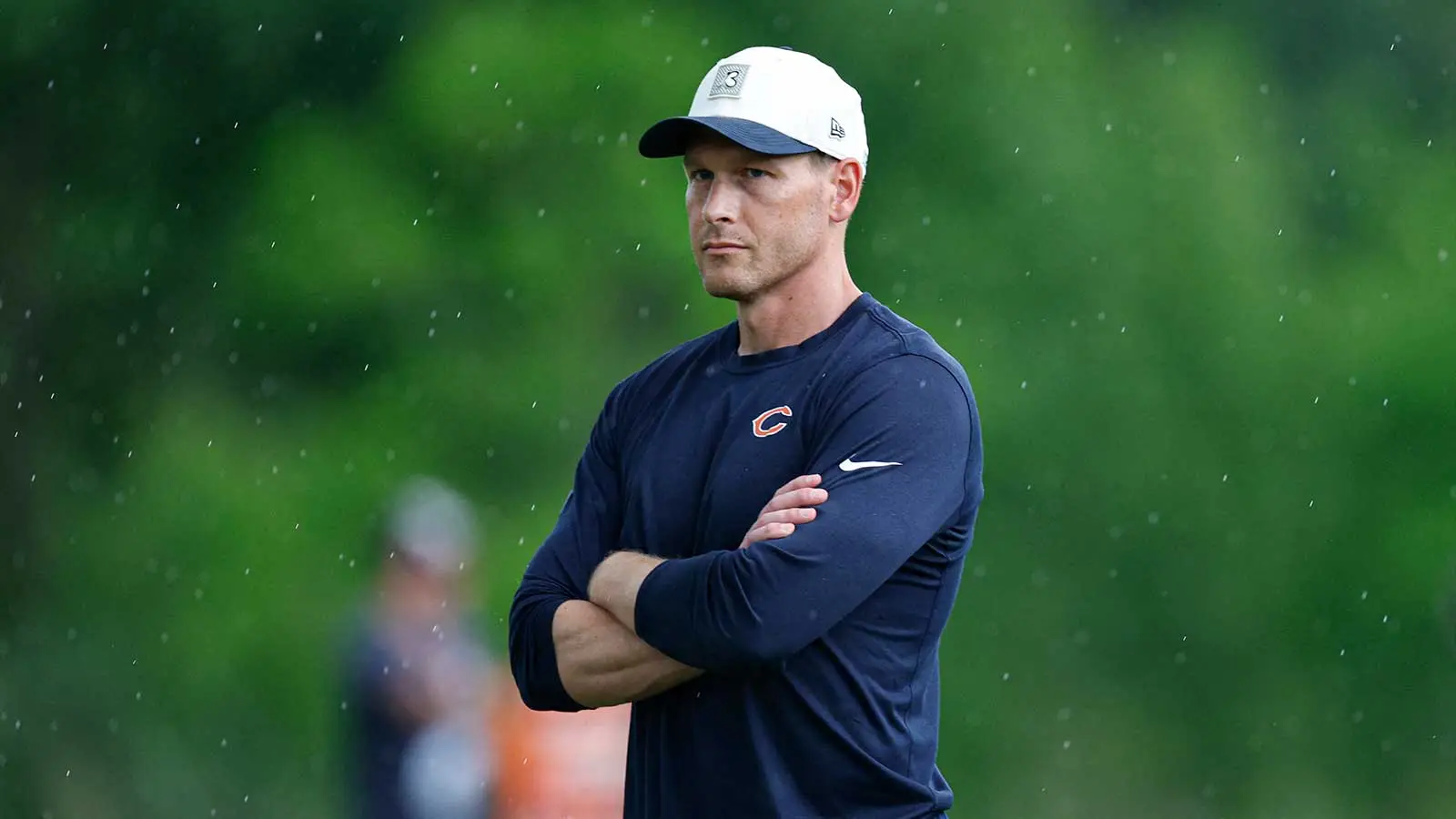
Ben Johnson built his reputation on an under-center, play-action-heavy attack. Now, with training camp underway, the Chicago Bears head coach is talking about giving quarterback Caleb Williams more chances to work from the shotgun and pistol this season.
Johnson made the comments during an appearance on the “Up & Adams Show” with Kay Adams, where he was asked directly about his preference for under-center play calls. He didn’t rule out change. “I think you can have success going from the gun or the pistol also, but there’s just things that we kind of hang our hat on in the running game that trickles out to the play action pass, to the movement series, that I think Caleb does a really good job of,” Johnson said, describing why the under-center scheme has worked so far without closing the door on more shotgun snaps ahead.
That’s notable given how far Chicago’s offense has already shifted. Williams came into the league as a shotgun-heavy passer at USC and as a rookie with the Bears. Chicago ranked among the top eight teams in the NFL last season in percentage of under-center snaps, a dramatic swing after Johnson’s arrival built the offense around the same bootleg and play-action framework he ran in Detroit. Adding more gun and pistol looks would give Williams a hybrid approach — the structure Johnson wants combined with the space Williams operated in for most of his career.
Williams finished his first year under Johnson with 3,942 passing yards and 27 touchdowns on a 58.1 percent completion rate, numbers that came with a Bears offense that leaned on the ground game to set up shots downfield. Adding more shotgun could open up quicker throws and more spread concepts without abandoning what already worked in 2025.
Wright’s Extension Reflects the Culture Johnson Built
The formation tweak is one piece of a bigger pattern in Chicago: players crediting Johnson for creating an environment where they’ve been able to perform at a new level. Right tackle Darnell Wright is the clearest example. The Bears and Wright agreed Tuesday to a four-year, $116 million extension with $93 million guaranteed, according to ESPN’s Jeremy Fowler and NFL Network’s Ian Rapoport. It’s the richest deal ever given to a right tackle and the most guaranteed money in NFL history for any offensive lineman.
Wright spoke about what set that run in motion. In a live update from The New York Times’ Athletic, Wright described the confidence Johnson gave him early on: “When he first got here, he instilled the confidence in me that I was going to be a part of the offense. I’ve never had a coach really come up to me and say, ‘We’re depending on you.'”
That trust paid off. Wright started all 16 games he played in 2025, earned second-team All-Pro honors, and has missed just two games across three NFL seasons. The Bears made him their guy up front, and it took only one season under Johnson for the payoff to show up in the pay stub.
| Bears OL Extension | Years | Total Value | Guaranteed |
|---|---|---|---|
| Darnell Wright (2026) | 4 | $116M | $93M |
| Penei Sewell, Lions (prior RT record) | 4 | $112M | — |
| Andrew Thomas, Giants | — | $117.5M | — |
Growing Pains Still Show Up in Camp
None of that means the offense is running smoothly every day. As reported by Kevin Fishbain of The Athletic, Tuesday’s practice was rough for the starting unit. Fishbain wrote that the Bears’ starting offense “had two interceptions, a fumbled snap, back-to-back false starts in a two-minute situation,” and the session ended with rookie receiver Luther Burden III on the ground after an incomplete pass, slow to get up.
Burden’s injury scare came on a hard hit from linebacker Devin Bush during a padded practice, and the rookie said afterward that he was okay. It was, by multiple beat accounts, the offense’s worst day of camp so far — pre-snap penalties piling up against a defense that had struggled for stretches of 2025 but has looked sharp early in camp.
Two interceptions and a fumbled snap don’t erase a season that put the Bears among the league’s top rushing offenses. But training camp exists to expose exactly these kinds of issues before they show up in games that count. Chicago still has weeks to smooth out the timing problems, and Johnson has been candid that Williams’ growth — including whatever new formation wrinkles get added — is a process, not a switch that flips overnight.
The bigger picture hasn’t changed: Johnson turned a middling offense into one of the league’s best in year one, Wright’s extension shows the front office believes the current group is worth building around, and the coaching staff is now testing how much further the scheme can stretch. Whether that means more shotgun snaps in Week 1 or a gradual mix-in over the season, it’s a live storyline through the rest of camp.