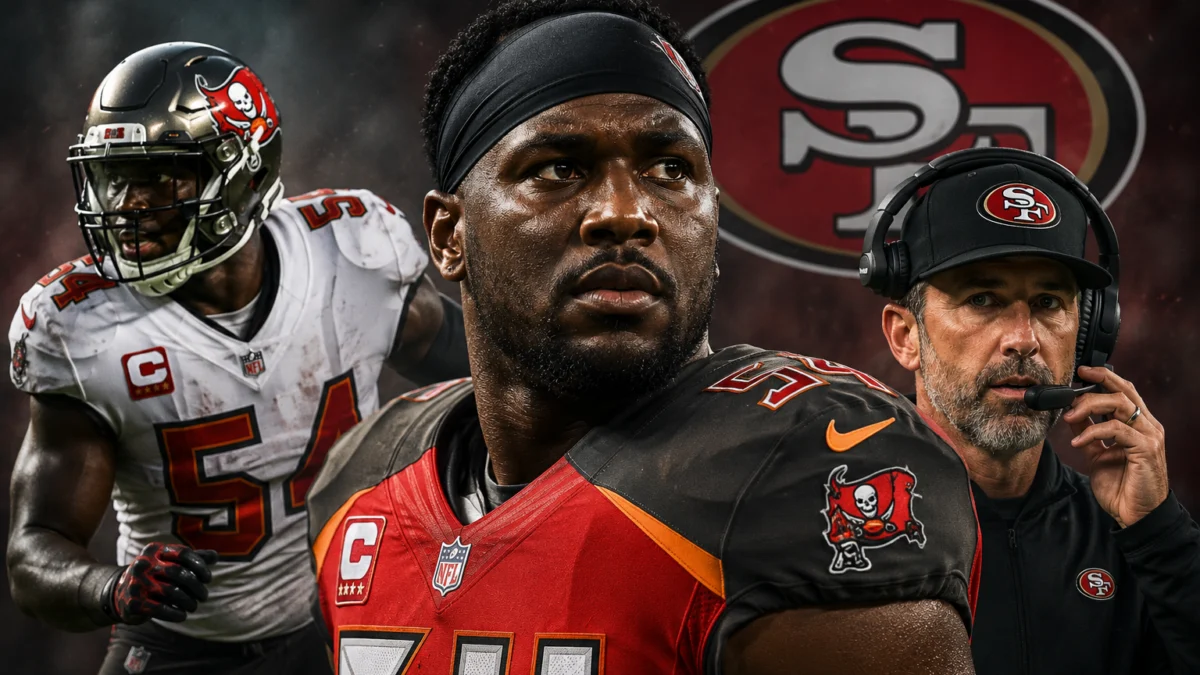
The San Francisco 49ers still carry questions around wide receiver Brandon Aiyuk’s future. The system around him continues to draw praise from people paid to stop it.
Retired All-Pro linebacker Lavonte David joined ESPN’s This is Football on Wednesday and left no doubt which offense gave him the most trouble during his 14 seasons with the Tampa Bay Buccaneers.
“The way they did things, they kept it similar by keeping big personnel in, but they can spread you out,” David said. “You got guys moving all over the place.”
He added that the 49ers made every formation and pre-snap look identical. Defenses could not get a clean read on run or pass. That uncertainty stayed with him long after the final whistle.
“They made everything look exactly the same. So you couldn’t get a read on whether it was a run or a pass. It definitely kept me up at night,” David said.
Motion and Personnel Created Constant Mismatches
Shanahan’s group used pre-snap movement to stress linebackers and safeties. Big personnel stayed on the field for power runs or play-action, then shifted into spread alignments. A linebacker who stayed home for the run suddenly had to chase a tight end or running back into the flat. One hesitation and the ball carrier hit open grass.
David described how the 49ers forced defenders into one-on-one situations across the field. Linebackers who built careers on filling gaps and delivering hits in the hole instead found themselves in space, trying to change direction against quicker skill players. Those open-field tackles carry extra cost over a full game.
The Buccaneers often stayed in base defense longer than they preferred because Shanahan’s run threat demanded it. Nickel packages that drop a linebacker for an extra defensive back became risky when the 49ers could still lean on inside zone or power concepts. Tampa’s front seven stayed on the field, and San Francisco attacked the resulting spacing.
Misdirection and Heavy Sets Opened Vertical Shots
Misdirection added another layer of stress. Play fakes and pulling linemen pulled linebackers toward the line of scrimmage. Once those defenders committed, seam routes and deep crosses appeared behind them. Shanahan also used heavier personnel groupings to set up those shots. Defenses loaded the box expecting run, then watched the ball sail over their heads.
Lavonte David on which offense gave him the most problems:
“San Francisco. The way they did things, they kept it similar by keeping big personnel in, but they can spread you out. You got guys moving all over the place… They made everything look exactly the same. So you couldn’t… pic.twitter.com/N6b2YF4km2
— Coach Yac 🗣 (@Coach_Yac) July 8, 2026
David faced this combination multiple times in NFC matchups where both teams pushed for conference positioning. The mental preparation required extra film study because the usual keys — personnel, alignment, backfield action — often pointed the wrong direction.
Even in retirement, David still highlighted how few clean reads the scheme allowed. The 49ers did not need to trick every defender on every snap. They only needed enough hesitation to create a window for the ball carrier or quarterback.
Scheme Reputation Holds Despite Roster Questions
Aiyuk’s contract situation adds another variable. The 49ers voided guarantees in his deal last year tied to recovery from a prior knee injury, and recent public comments from the receiver have kept the matter active. Training camp approaches with his roster status still fluid.
Absolutely awesome This Is Football with Lavonte David.
I asked him the biggest scheme change during his career and he gave a *great* deep dive into how offenses create mismatches using heavy personnel—especially McVay/Shanahan.
“Everyone wants to keep us out of nickel.” pic.twitter.com/6uRFzjZS9b
— Kevin Clark (@bykevinclark) July 8, 2026
David’s comments underscore a larger point about the offense. The system is built on timing, pre-snap movement and personnel versatility more than any single receiver. The same concepts that bothered David for years remain in place regardless of who lines up outside.
Opponents this season will face the same film study David described. Clean looks that hide intent. Motion that pulls defenders out of position. Heavy sets that suddenly stretch the field vertically. The 49ers have leaned on those elements through multiple roster changes. Defenses that try to guess instead of react will keep paying the price.