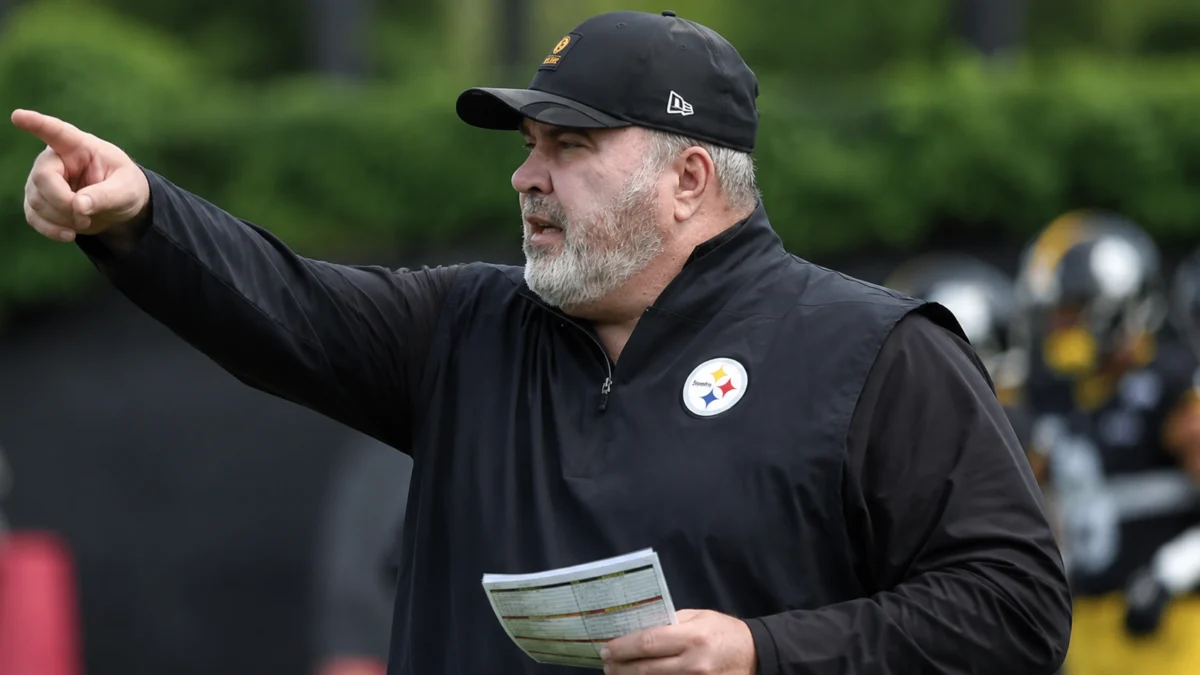
Mike McCarthy hasn’t coached a single regular-season game for the Pittsburgh Steelers, and he’s already been tagged with one of the hottest seats in the NFL. According to RotoWire’s 2026 Coach Pressure Index, published July 20 by Thomas Leary, McCarthy checks in at No. 3 overall with a score of 72 out of 100 — trailing only Jets coach Aaron Glenn (78) and Colts coach Shane Steichen (74).
The Steelers haven’t won a playoff game since Jan. 15, 2017, when they beat the Kansas City Chiefs 18-16 in the divisional round on the strength of six Chris Boswell field goals. That drought, combined with the retirement of longtime coach Mike Tomlin after nearly two decades on the sideline, is a big part of why McCarthy is starting his Pittsburgh tenure under a magnifying glass.
Why McCarthy Landed on the Hot Seat List
RotoWire’s index scores all 32 head coaches on a 100-point scale built from five weighted categories: Job Security Risk (30 points), Win-Now Mandate (20), Quarterback Situation Volatility (20), Legacy/Succession Burden (15) and Market/Media Scrutiny (15). The higher the number, the more heat a coach is carrying into the season — the model isn’t necessarily predicting firings, but measuring pressure.
McCarthy sits just ahead of new Ravens coach Jesse Minter, who arrived from the Los Angeles Chargers and is tied for fourth with Eagles coach Nick Sirianni at 71. Leary tied McCarthy and Minter together as a pair walking into nearly identical circumstances.
“Both stepped into openings created by the offseason’s headline story: two of the league’s longest-tenured coaches are gone from Pittsburgh and Baltimore, and their successors carry the full weight of that succession burden from day one,” Leary wrote.
He contrasted that with John Harbaugh, who left Baltimore for the Giants and landed at a comfortable 38 on the same scale — proof, Leary argued, that the pressure measured here is about circumstance, not resume.
Where the Numbers Hurt McCarthy Most
Job Security Risk is the one category where McCarthy catches a break. Pittsburgh isn’t moving on from a first-year coach regardless of how 2026 goes, so that score stays low almost by definition.
Everything else piles up. The quarterback room behind Aaron Rodgers is thin on proof: Will Howard and Drew Allar have never taken an NFL regular-season snap, and Mason Rudolph is a career backup who’s shown he can spot-start but not that he’s a long-term answer. None of the three has established himself as a franchise quarterback, and that uncertainty feeds directly into the model’s Quarterback Situation Volatility score.
McCarthy also takes a hit on Win-Now Mandate, Legacy/Succession Burden and Market/Media Scrutiny. Pittsburgh’s front office believes it built a roster capable of winning now, and it moved on from a coach who’d led the franchise for nearly 20 years to make that happen. Add a Pittsburgh media market that won’t stay quiet if the season slips, and the score climbs fast.
The Ranking Overreaches
Here’s the problem: ask 10 general managers around the league to name coaches who could realistically be fired by the end of this season, and McCarthy likely doesn’t make more than a handful of those lists — and he’s certainly not cracking anyone’s top three.
Run the worst-case scenario. Say the Steelers collapse and finish 5-12. Even then, McCarthy isn’t getting fired after one season. Owner Art Rooney II and general manager Omar Khan didn’t hire a coach with McCarthy’s résumé — a Super Bowl title and 13 playoff appearances across parts of 13 seasons in Green Bay — to pull the plug after 17 games, no matter how ugly it gets. The Rooney family has employed four head coaches since 1969. Patience with a first-year hire, even a rough one, is close to organizational doctrine at this point.
McCarthy also didn’t build this quarterback room. He inherited it. And nothing about his track record suggests he’ll buckle under the weight of replacing a franchise-defining coach, which is functionally what the succession-burden score is trying to capture.
Pittsburgh’s Season Ahead
Models like RotoWire’s can be useful shorthand for where pressure is concentrated across the league, and the methodology is transparent about what it’s measuring — circumstance, not performance history. But applying it to a franchise built on continuity, with an owner who has shown no appetite for coaching change, stretches the data past what it can responsibly predict.
McCarthy’s timeline in Pittsburgh remains an open question. What’s not in question is that it won’t be decided by one season, no matter how the Coach Pressure Index reads in July.
| Rank | Coach | Team | Score |
|---|---|---|---|
| 1 | Aaron Glenn | Jets | 78 |
| 2 | Shane Steichen | Colts | 74 |
| 3 | Mike McCarthy | Steelers | 72 |
| T4 | Jesse Minter | Ravens | 71 |
| T4 | Nick Sirianni | Eagles | 71 |